
|
|
Page of the allmighty PIRATES !!
:)
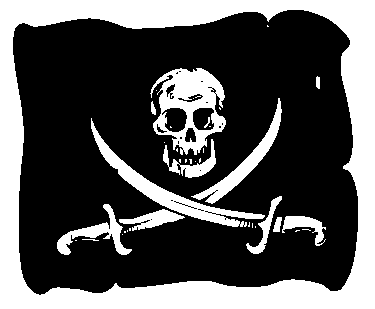
Piracy has existed since the earliest times sailors put
to sea. However, most Americans when asked about pirates probably picture the
Caribbean pirates of the seventeenth through nineteenth centuries. Stories of
characters like Blackbeard and Henry Morgan, along with legends of their hidden
treasure, continue to fascinate us.
A good introduction I found about pirates is written by Krzysztof Wilczynski (you
can found more on his site, Pirates Info )
The history of piracy dates back more than 3000 years,
but its accurate account depends on the actual meaning of the word ‘pirate’. In
English, the word piracy has many different meanings and its usage is still relatively
new. Today, some uses of the word have no particular meaning at all. A meaning
was first ascribed to the word piracy sometime before the XVII century. It appears
that the word pirate (peirato) was first used in about 140 BC by the Roman historian
Polybius. The Greek historian Plutarch, writing in about 100 A.D., gave the oldest
clear definition of piracy. He described pirates as those who attack without legal
authority not only ships, but also maritime cities. Piracy was described for the
first time, among others, in Homer's The Iliad and The Odyssey. For a great many
years there remained no unambiguous definition of piracy. Norse riders of the
9th and 11th century AD were not considered pirates but rather, were called "Danes"
or "Vikings". Another popular meaning of the word in medieval England was "sea
thieves". The meaning of the word pirate most closely tied to the contemporary
was established in the XVIII century AD. This definition dubbed pirates "outlaws"
whom even persons who were not soldiers could kill. The first application of international
law actually involved anti-pirate legislation. This is due to the fact that most
pirate acts were committed outside the borders of any country.
Read more on Pirates Info
My favourite pirate is Henry Every - here's a short
biography of this amazing man.
His flag:

Henry Every was born about 1653 (or perhaps as late as 1665) near Plymouth, England. He was so successful at piracy that in his day he was known as the 'Arch Pirate', and the legendary plunder of men like him and Thomas Tew caused a 'Red Sea Fever' to spread through America, the Caribbean, and England.
After an early period of unlicensed slave trading out of the Bahamas, Every was by June 1694 a first mate on the 46-gun Spanish privateer the Charles II, which was assigned to attack French smugglers on Martinique. The crew became increasingly irritated after many months of no pay, and Every led a mutiny while near the Spanish town of La Coruna.
He was promptly elected captain of the new Fancy, which was sailed north of Madagascar only to capture one French and three English ships, adding many to his crew. Near Guinea, Every would lure out locals under pretense of trade and them take them as slaves. He was well established in a career that would prove so successful, he would later be declared outside of the Acts of Grace (beyond pardon).
In early 1695 while in the Red Sea, Every forged a pirate flotilla of 5 ships commanded by pirates such as Thomas Tew, William Want, Thomas Wake, and William May. With these he soon attacked the Grand Mogul's Fatah Mohammed and the larger 40-gun Gang-i-Sawai, which were busy accompanying a pilgrim fleet returning from Mecca. The Gang-i-Sawai lost its mainmast, and a cannon exploded on deck, shortening the fight and resistance. The passengers and crew were brutalized in hope that the locations of any secret stash would be revealed; some jumped ship, and some of the women committed suicide. The search yielded 600,000 Pounds in gold, silver, and jewels in one of the largest hauls ever, and each man got over 1000 Pounds, younger ones - 500.
Soon thereafter, the flotilla split up. Even some of Every's crew left, but he got slave replacements before heading to St. Thomas and finally New Providence. After buying protection from the Bahamian governor Nicholas Trott and having a big party, Every and company sailed to Jamaica in June 1695 and tried to buy a pardon from governor William Beeston for 24,000 Pounds. Beeston refused, and they went back to the Bahamas. Although the Fancy had been given to Trott, the indifferent crew drove the tired vessel ashore and split up. Some men went to America, and a few went to parts unknown.
Every changed his name to Benjamin Bridgeman and grouped some sloops to sail with the remaining crew to the British Isles. Lying low and acting inconspicuous was not their strong suit, and several of them were quickly caught by October 1696. Those who were not hanged were deported to the States. Every, however, disappeared after arriving in Ireland and was never heard from again. There were various reports of his being seen in Ireland, Scotland, Wales, and even on a tropical island.
Henry Every probably did more than any other pirate in influencing others to either pursue piracy or to pursue pirates. The severe reaction of the Moguls toward the East India Company jeopardized its existence and exemplified a growing anti-English, anti-European sentiment that later resulted in widespread independence movements.
Pirates stuff :))))

 |
 |
 |




More to come...
penis enlargement vimax
magna rx